Developer tooling · 2026
Context Mesh
Code intelligence that cuts AI agent token spend by 99%.
- Role
- Design and engineering
- Timeline
- Five months of active development
- Status
- Private
- Year
- 2026
01 / The problem
The problem
Ask an AI coding agent what calls a given function. Without an index it greps, gets partial matches, opens four files to confirm, spends several thousand tokens, and still misses the caller that reaches the function indirectly.
That loop repeats on every question. On a large repository it becomes the dominant cost of working with an agent, and it gets worse precisely when the codebase is big enough for the help to matter most.
02 / What it does
What it does
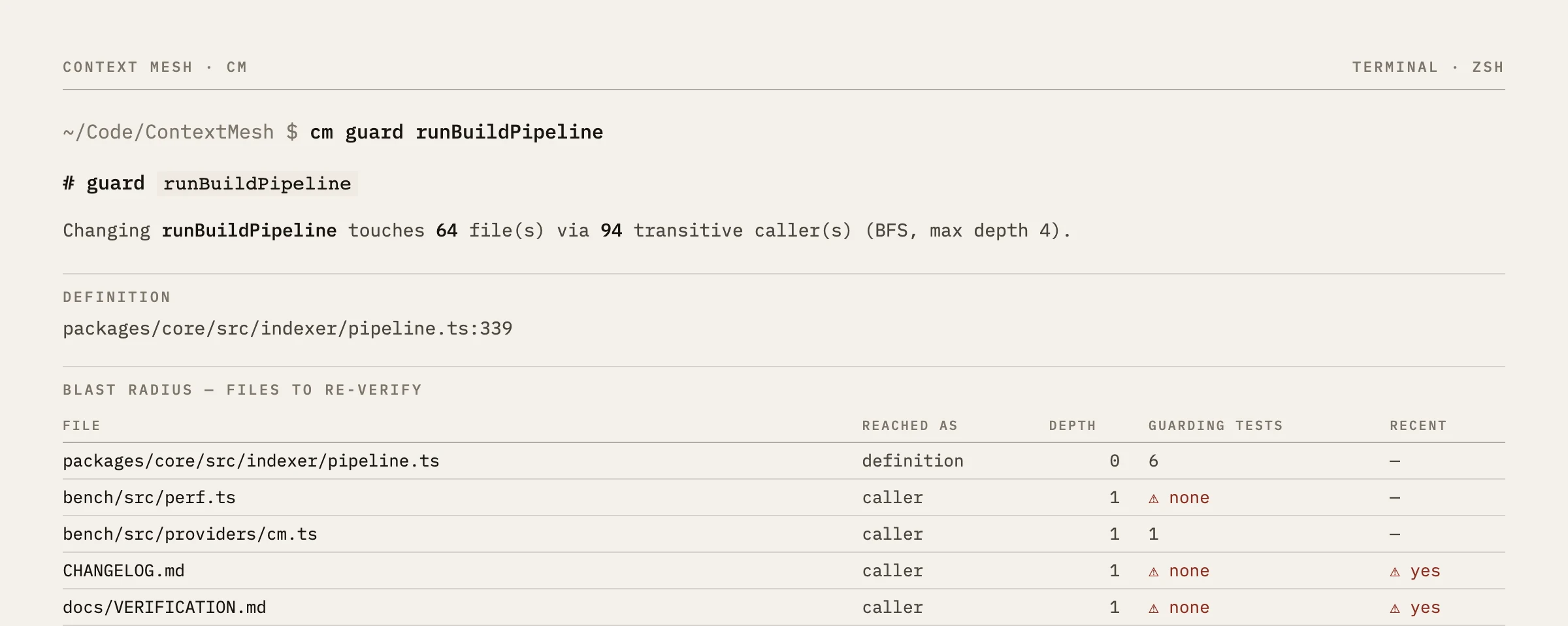
Context Mesh indexes a repository once and then answers structural questions (where is this defined, what calls it, what depends on it) in a single lookup instead of a search loop.
The design decision that carries the project is that one index is exposed three ways: as static files any tool can read, including editor modes that cannot call tools at all; as a command-line binary that runs anywhere a shell does, including inside subagents that do not inherit their parent's tool registrations; and as an MCP server for hosts that support it. Keeping all three in parity from a single build is the part that is easy to get wrong.
03 / The measurements
The measurements
There is a benchmark in the repository, it runs in CI, and it is pinned to specific public commits so the results reproduce.
Retrieving the same answers against a grep-loop baseline: 5,202 tokens and 11 tool calls, versus 2,082,608 tokens and 654 tool calls. Across a broader eleven-task run over four open-source repositories, task success was 100% against the baseline's 63.6%.
One disclaimer, written against my own results: the scripted judge does not account for how a real model degrades when a huge context is dumped on it, so the success-rate gap is softer than the number suggests. Read the cost figures as the result and the success rate as directional.
04 / How it is built
How it is built
tree-sitter does the parsing, which lets the call graph work across languages rather than just the one the tool happens to be written in. Route extraction covers 27 web frameworks. The call graph crosses language boundaries too: a React Native bridge call resolves through to its Swift or Kotlin implementation.
Incremental rebuilds are verified byte-identical to a full rebuild by the performance harness, and run between 1.4× and 14× faster depending on how much changed. An optional SQLite full-text index engages automatically once a repository is large enough to need it.
1,729 test cases. CI runs build, typecheck, the test suite and a benchmark regression gate on every push, so a change that makes retrieval worse fails before it merges, whether or not anyone noticed.
05 / Status
Status
Private. It is packaged for release and has not been released: the repository is not public and nothing is on any package registry. It is in daily use across my own projects, including the site you are reading this on.
Stack
- 01TypeScript, Node 20+, ESM monorepo
- 02tree-sitter (WASM) for multi-language parsing
- 03Model Context Protocol server with 29 tools
- 04Optional SQLite FTS5 search accelerator
- 05Vitest, CI with a benchmark regression gate